























Startup Funding Explained in Simple Words (2025 Guide)
Learn startup funding in simple words. Understand seed funding, series rounds, investors, equity, valuation, and how startups raise money.
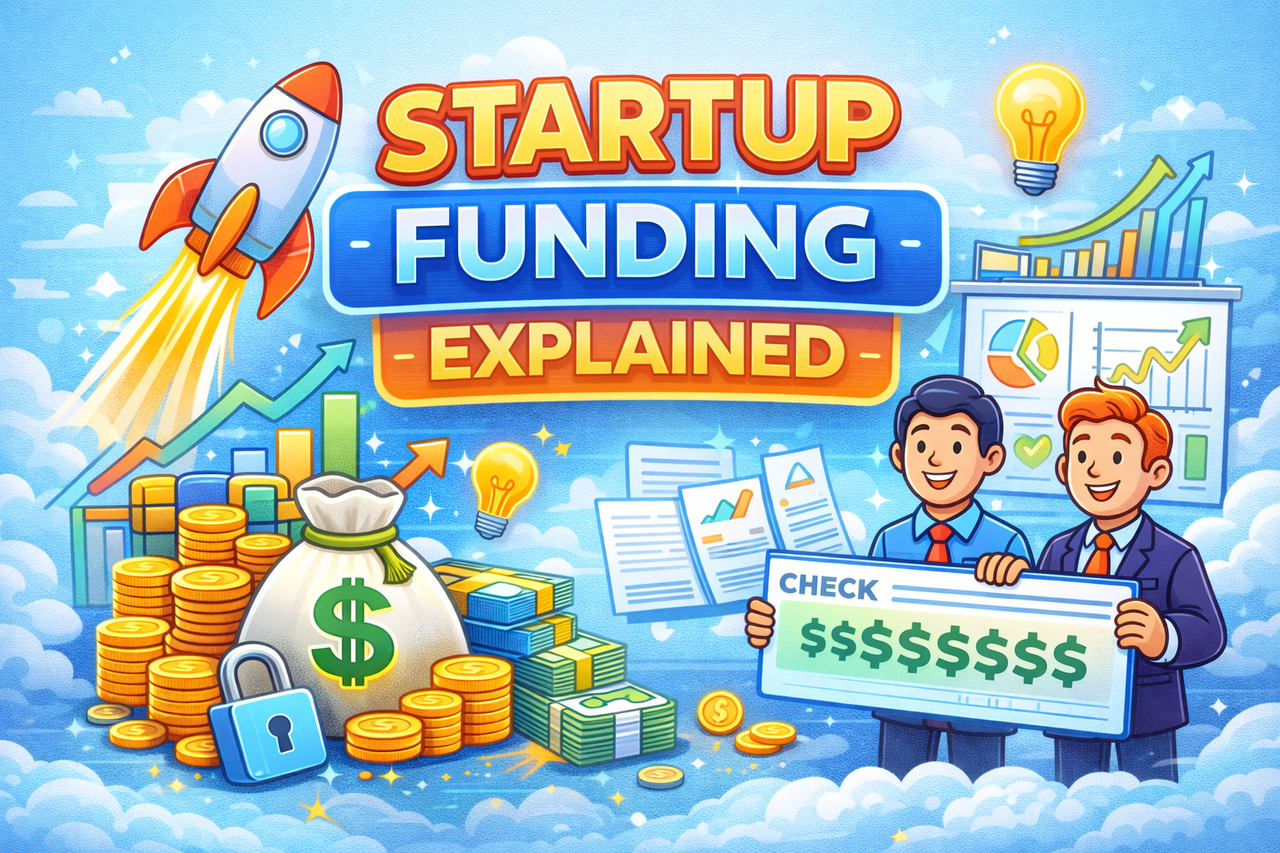
Startup Funding Explained
Introduction
Every successful startup you hear about today—whether it's Zomato, Swiggy, Ola, or Paytm—has gone through multiple stages of funding.
But beginners often struggle to understand how startup funding works, who invests, why they invest, and what founders give in return.
The truth is: startup funding is much simpler than it sounds once you understand its basics.
In this guide, we’ll break down the complete startup funding process in simple words, with real-world examples.
By the end, you’ll clearly understand how startups raise money and grow into big companies.
Table of Contents
-
What Is Startup Funding?
-
Why Startups Need Funding
-
Types of Startup Investors
-
Startup Funding Stages Explained
-
How Startup Valuation Works
-
How Equity Sharing Works
-
Documents Needed for Funding
-
How Startups Actually Raise Money
-
Key Takeaways
-
FAQs
-
Conclusion
1. What Is Startup Funding?
Startup funding is the money a business receives from investors to grow, expand, or launch a new idea.
In return, the investor gets equity (ownership) or sometimes interest returns.
Simple Example
A founder has a great idea but no money.
An investor gives ₹20 lakh in exchange for 10% ownership in the startup.
This is funding.
2. Why Startups Need Funding
Startups need capital for different reasons depending on their stage.
Common reasons for funding
-
Building product or app
-
Marketing and user acquisition
-
Hiring skilled employees
-
Scaling operations
-
Expanding across new cities
-
Research & development
Example
A food delivery startup needs money to build an app, hire delivery partners, and run ads.
Without funding, it cannot grow quickly.
3. Types of Startup Investors
Different investors support startups at different stages.
3.1 Founders & Friends (Bootstrap)
Initially, founders use their own savings.
Family and friends may also contribute.
3.2 Angel Investors
Wealthy individuals who invest early in startups.
They take more risk because the startup is young.
Examples
-
Ratan Tata (invests in Indian startups)
-
Kunal Shah (Cred founder)
3.3 Venture Capital (VC) Firms
Professional investment firms that invest large amounts in growing startups.
Popular VC Firms
-
Sequoia Capital
-
SoftBank
-
Tiger Global
-
Accel
VCs invest when the startup shows growth potential.
3.4 Incubators & Accelerators
Organizations that support startups with:
-
Funding
-
Mentorship
-
Office space
-
Training
Examples
-
Y Combinator
-
Techstars
3.5 Crowdfunding
People invest small amounts through online platforms.
Platforms
-
Kickstarter
-
Indiegogo
4. Startup Funding Stages Explained
This is the most important section beginners should understand.
Startups don’t get huge money in one go—they raise it in rounds.
4.1 Pre-Seed Funding
The earliest stage.
Used for:
-
Idea validation
-
Market research
-
Basic product development
Funding sources:
-
Personal savings
-
Friends/family
-
Pre-seed angel investors
4.2 Seed Funding
Helps build the main product and get first customers.
Used for
-
MVP (Minimum Viable Product)
-
Marketing
-
First hiring
Example
A startup receives ₹50 lakh from angel investors to launch the first version of its app.
4.3 Series A Funding
For startups that already have customers and want to scale.
Used for
-
Expanding operations
-
Strong marketing
-
Growing team
VCs enter at this stage.
4.4 Series B Funding
For high-growth companies.
Used for
-
Expansion to new cities/countries
-
Improving technology
-
Brand building
Startups now show steady revenue.
4.5 Series C, D, and Beyond
These rounds are for companies that become major businesses.
Used for
-
Acquisitions
-
Global expansion
-
Developing new products
Investors expect big returns at this stage.
4.6 IPO (Initial Public Offering)
The final stage.
The startup becomes a public company and sells shares to the public.
Examples
-
Zomato IPO
-
Nykaa IPO
5. How Startup Valuation Works
Startup valuation means calculating what the company is worth.
Factors affecting valuation
-
Market size
-
Product uniqueness
-
Revenue
-
User growth
-
Founder experience
-
Competitors
Simple Example
If a startup is valued at ₹5 crore and gets ₹50 lakh funding, the investor receives 10% equity.
6. How Equity Sharing Works
Equity is the percentage of ownership given to investors.
Why equity matters
-
More funding = more equity dilution
-
Founders must balance ownership
Example
A founder owns 100%
Raises funding and gives investors 20%
Now founder owns 80%
7. Documents Needed for Funding
Startups need proper documents to receive investments.
Important Documents
-
Pitch Deck
-
Business Plan
-
Financial Projections
-
Cap Table (Equity chart)
-
Traction Metrics (users, revenue)
-
Legal Documents
Pitch Deck Includes
-
Problem
-
Solution
-
Market size
-
Business model
-
Revenue plan
-
Competition
-
Team
-
Funding ask
8. How Startups Actually Raise Money
This is how funding happens in real life.
Step-by-step process
-
Build MVP
-
Show early traction
-
Prepare pitch deck
-
Approach investors
-
Present idea
-
Negotiate valuation
-
Due diligence
-
Sign legal agreements
-
Receive funds
Example
A fintech startup builds a basic app → gets 10,000 users → pitches to investors → raises ₹1 crore in seed funding.
Key Takeaways
-
Startup funding helps founders grow faster.
-
Funding rounds include pre-seed, seed, series A, B, C, etc.
-
Investors get equity in exchange for money.
-
Valuation decides how much ownership the founder gives.
-
Documentation and traction play a major role in attracting investors.
FAQs
1. What is the simplest meaning of startup funding?
Startup funding means raising money from investors to build or grow your business.
In return, investors receive equity or returns.
2. How do startups get money?
Startups raise money through angel investors, venture capital firms, crowdfunding, or incubators.
They pitch their idea and share equity for investment.
3. Do all startups need funding?
No. Some startups grow with bootstrapping (own money).
Funding is needed only if the business wants fast growth.
4. What is seed funding?
Seed funding is early-stage funding used to launch the product and get initial customers.
It’s usually given by angel investors.
5. What do investors gain from funding?
Investors get ownership (equity).
If the startup becomes successful, the value of their equity grows, giving them high returns.
Conclusion
Startup funding is the fuel that helps new businesses grow rapidly.
From early-stage idea validation to global expansion, every funding round plays a critical role in building a successful startup.
Understanding funding models, investors, equity, and valuation helps new founders plan smarter and pitch better.
Whether you aim to launch a startup, invest in one, or simply learn the ecosystem, knowing how funding works is the first step toward success.
With the right preparation and vision, any idea can grow into a powerful business.
What's Your Reaction?